
It seems like rainy days are the new normal around here, and so there is nothing to be done other than dealing with it. For me, that means doing the same old shit I always do, albeit a tad less comfortably. So, I’m still going to engage in a morning walk, even if it’s a boring, flat one.
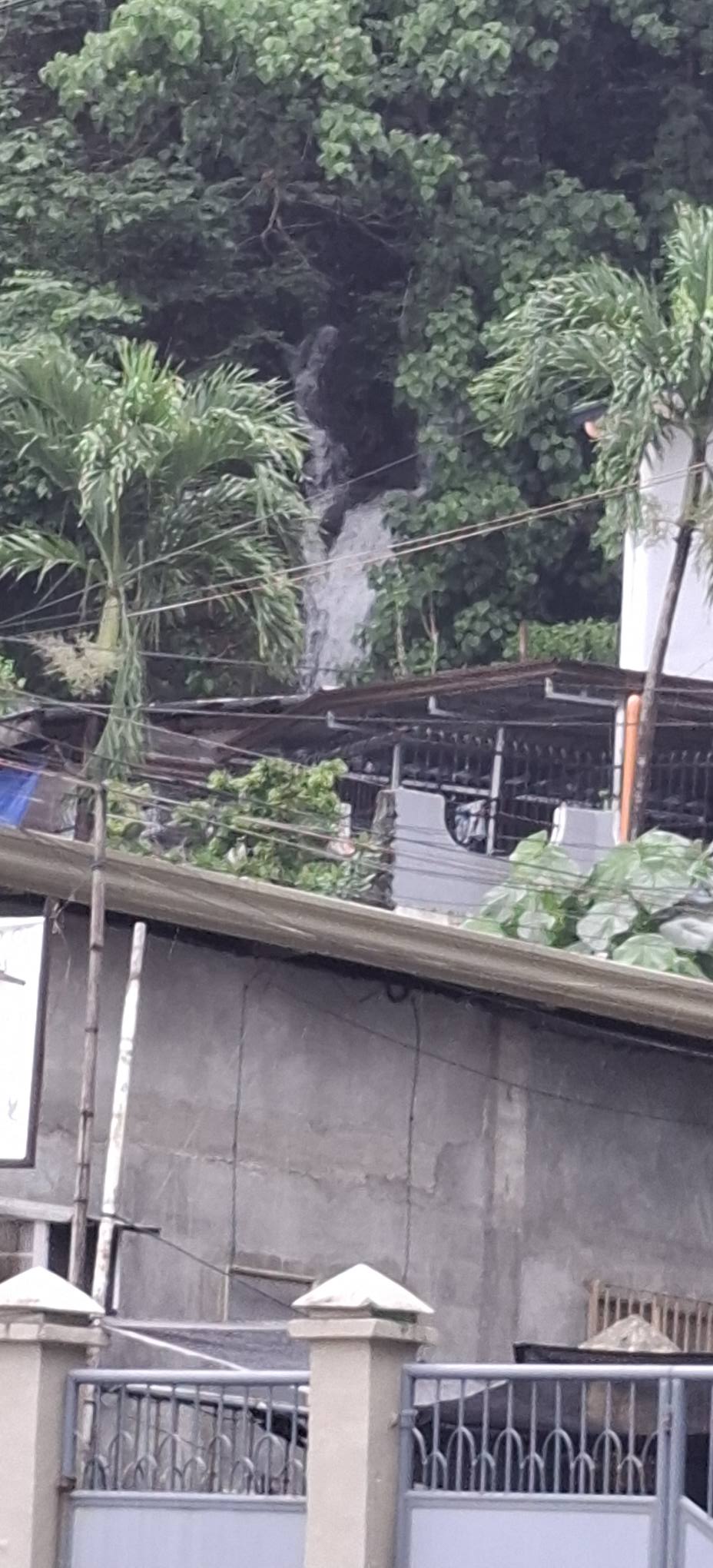
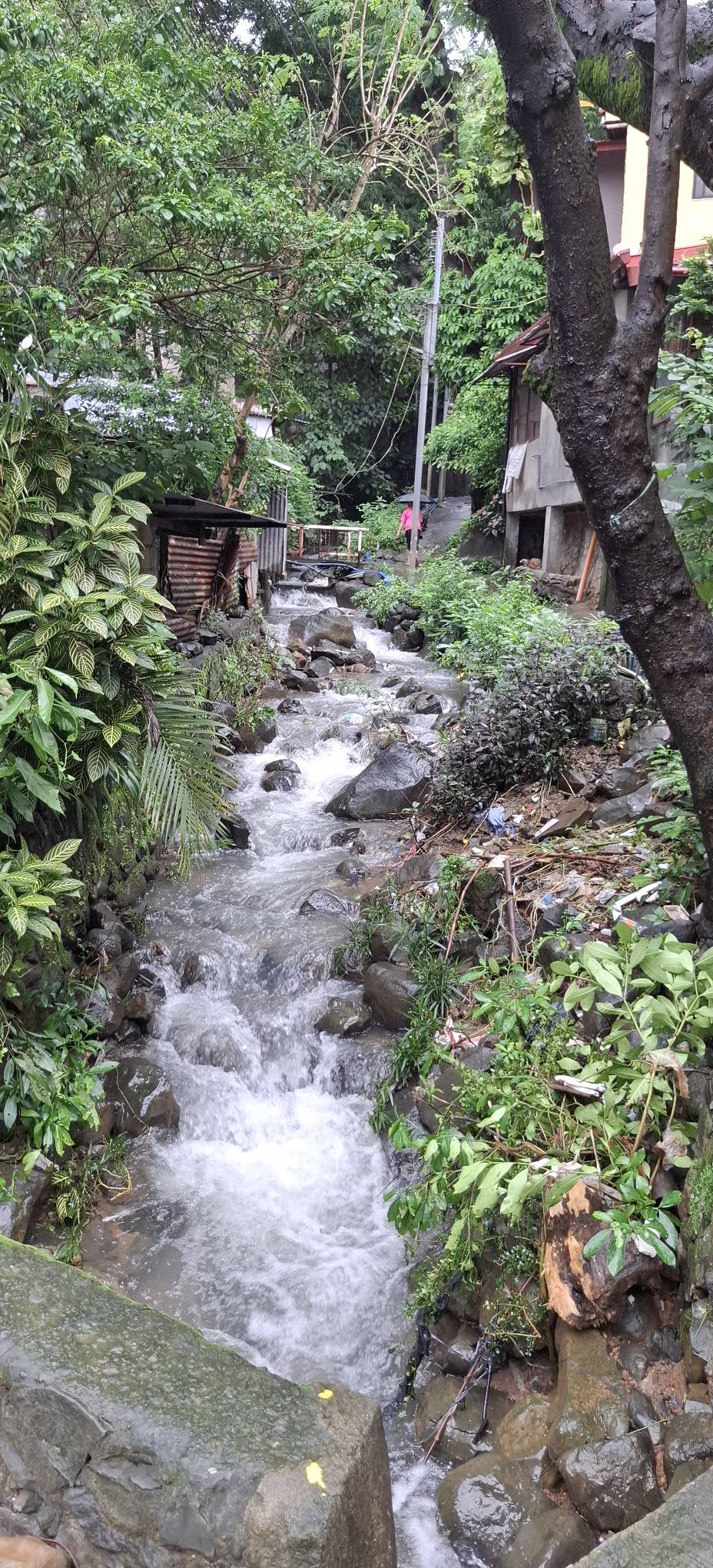
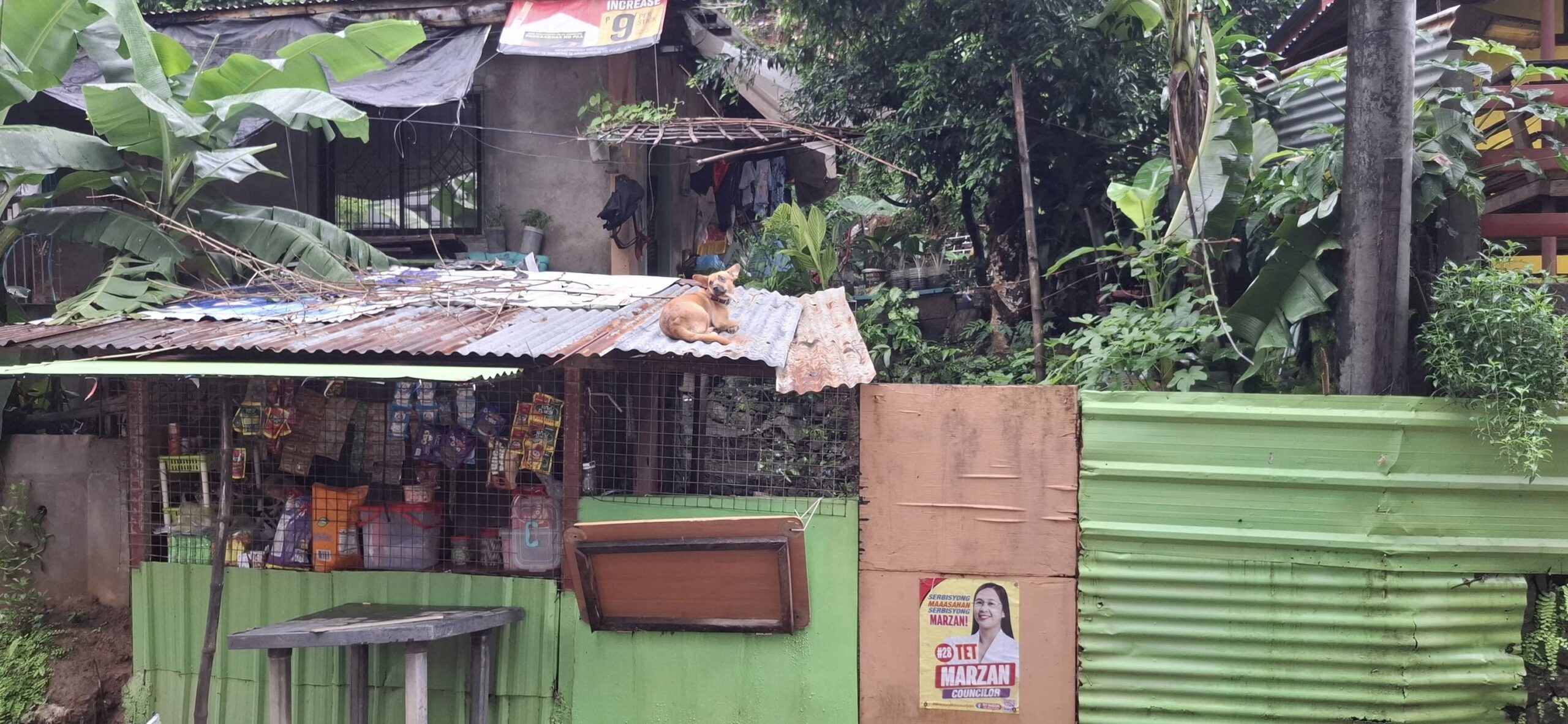
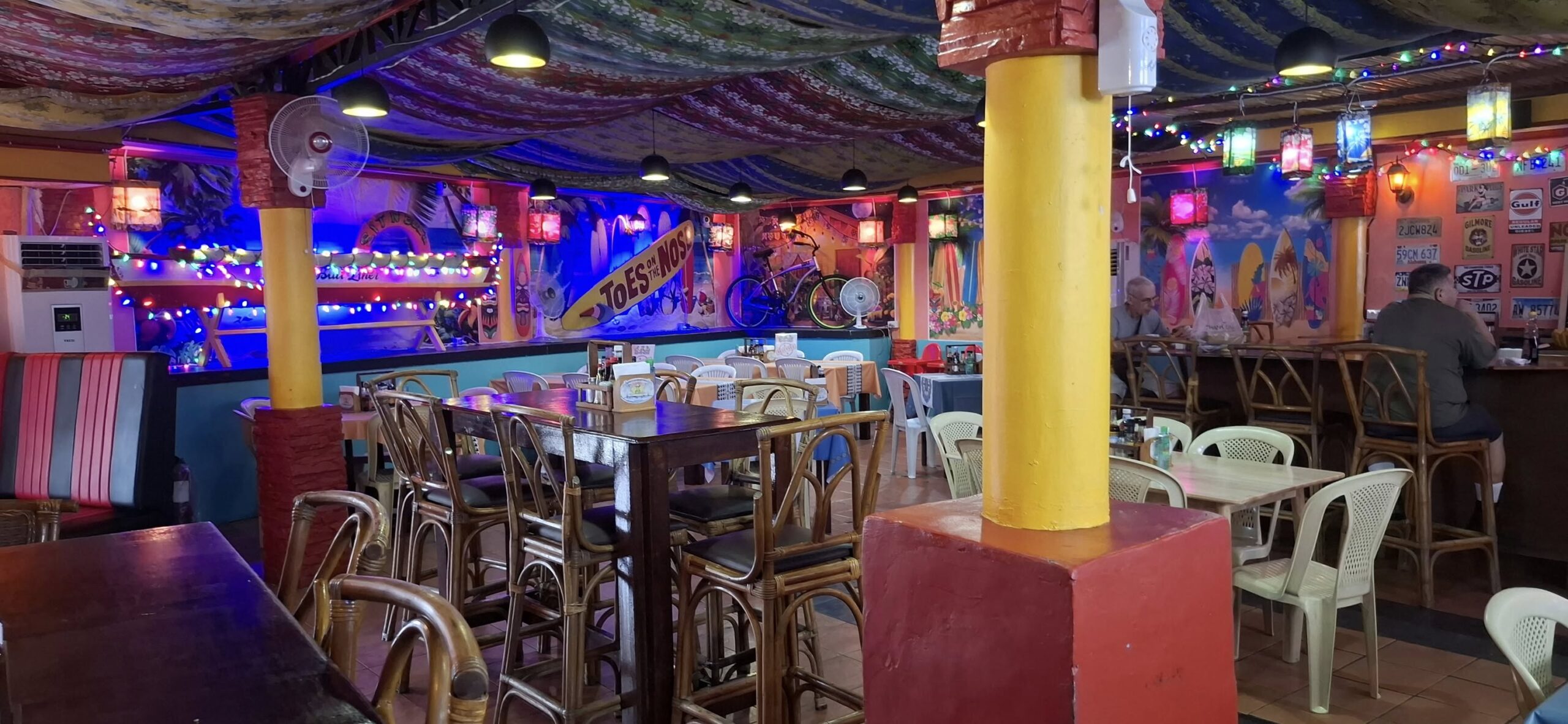
At the 5K mark, I was soaked and hungry. I was also just around the corner from Sit-n-Bull, so I popped in and ordered a Malibu chicken burger for takeout.
Went home, dried off, ate, napped, did my blogging chore, then showered up and got ready for whatever the evening held in store. We had planned to attend a cookout gathering at a fellow Hasher’s house, but alas, he announced his neighborhood was flooded and the event was canceled. So, we popped open our umbrellas and made our way to Harley’s on Baloy for dinner.




After our meal, we took a trike into “downtown” Barretto and paid a visit to It Doesn’t Matter. When we’d had enough of that, we walked a block up the highway and did our nightcap at Alaska. It was also mostly devoid of patrons, but surprisingly, most of the staff were missing as well—only two dancers (usually eight) and two waitresses (usually four). The waitress who served us explained that the bad weather and flooding had kept most of her coworkers at home (she lives upstairs in the accommodation provided by the bar, so she wasn’t inconvenienced by coming to work). We bought her a couple of drinks, and she and Swan chatted in Tagalog, leaving me to some quiet time with my friend Zero.
And then it was time for home. Not much of a day, but better than nothing.

All I can say to Mother Nature is, bring it on, bitch!
I’ve moved on to May 2010 in my journey through the LTG archives. This post was chock full of pictures from my trek to Doseonsa Temple in Seoul (I spelled it wrong back then). It was a great experience back then, but reliving the memory now has an element of sadness. I miss my life in Korea.

Today’s YouTube video is a chilling depiction of what war with China may look like in this part of the world. I hope it doesn’t happen in my lifetime because otherwise, I expect it would result in the end of my life.
There’s always a reason to smile.



I just looked outside and was surprised to see this:
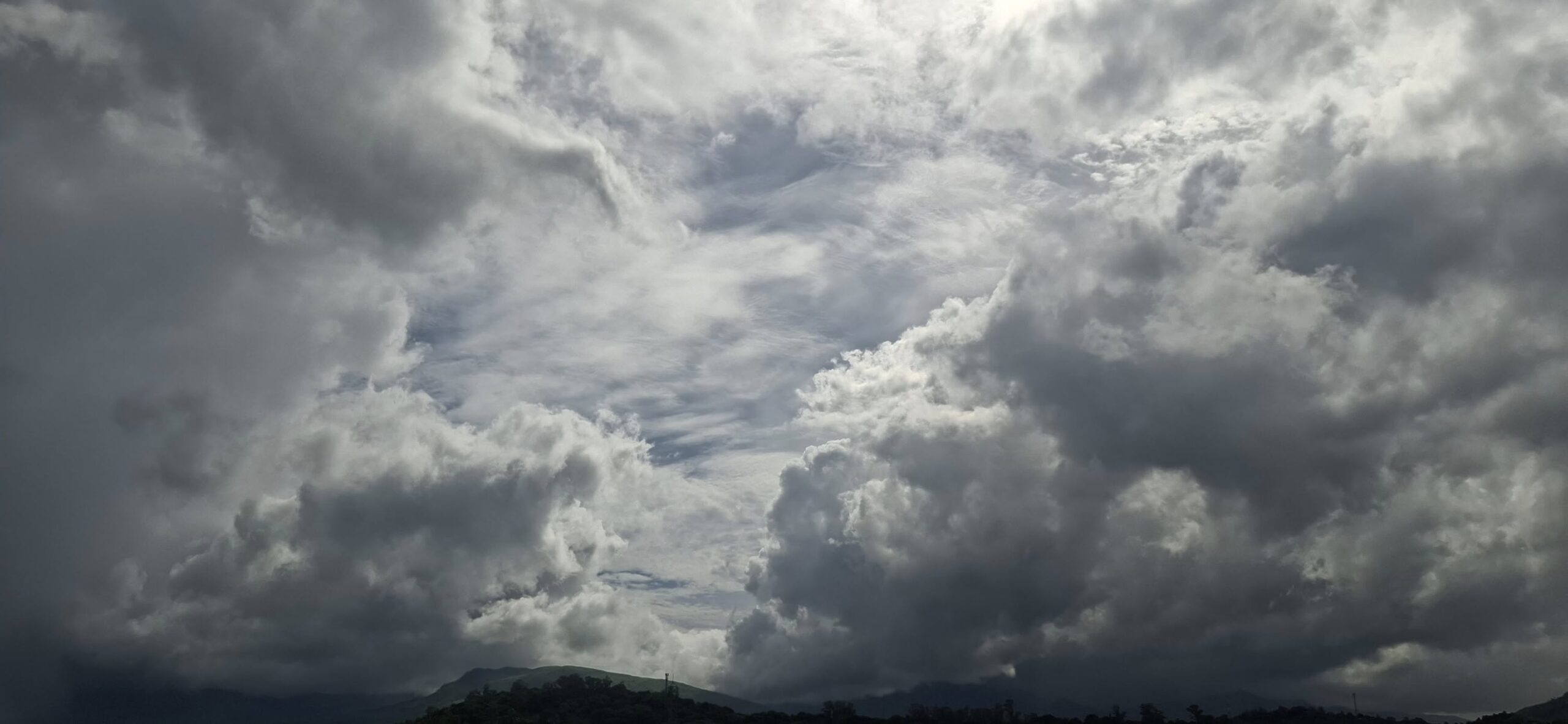
We shall see what tomorrow brings.
Your fish & chips look to be the size of checkers.
We were hit really hard last night–lots of wind accompanied by heavy rains.
Is this different systems sweeping through, or is it just one system that refuses to leave? I haven’t been following the weather in your part of the world.
re: Doseonsa
So that’s 道詵寺 in Chinese. It’s named after a monk with the dharma name of 道詵/도선/Do-seon (lit. “Tao-speak,” i.e., one who tells of the Way).
Even though “Tao” is not a Buddhist notion, East Asian Buddhism is highly syncretistic, so it has concepts from Taoism woven into it. For example, when the notion of “bodhi” (enlightenment) came to China from India, it got rendered as seong-do/성도/成道 (“attaining the Way”).
Translations like these weren’t a deliberate attempt to force Taoism into Buddhism; the Indian monks (like Kumarajiva) who learned Chinese and spread the dharma into China were trying to explain Buddhist concepts through the local vernacular. This can be a dangerous way to export or market a religion because of the risk that people will miss your essential point, but as a practical matter, you can’t expect a religion to settle in a new country/culture unless you convey its ideas in the local idiom. Even the Catholic Church eventually recognized this reality during Vatican II (1962-65), when the attendees agreed henceforth to hold masses in the local language instead of insisting on using Latin, a dead language that natives in their respective countries didn’t understand.
Islam is almost as widespread as Christianity these days, and its texts are generally taught in Arabic even though the locals might not be Arabic speakers (e.g., Afghans who speak Pashto, Dari, or Urdu). Arabic is considered God’s default language, even though he speaks all languages, so the truest Qur’an is the version written in Arabic. And if you’re in a madrassa but you don’t understand Arabic, that’s okay because there’s power inherent in the recitation of the holy words (Hindus believe this, too).
Well, enjoy the rain. I hope it brings a bit of coolness with it.
Kev, the fish chunks, albeit small, were thicker than a cracker at least.
As I understand it, we had a convergence of three tropical depressions that kept feeding each other. After six days of stormy weather, it appears they have moved on. Now it is just back to “normal” rainy season. The main difference is the intensity. And yes, it does cool things off. There has even been a day or two when I didn’t need my bedroom fan.
Thanks for the insights on the interplay of religious beliefs and the languages that they use. As a non-believer in any of the doctrines, it strikes me as an intellectual surrender to indoctrination. But what do I know? (Just in case I’m wrong, forgive me, Jesus, for I have sinned.)
As a non-believer in any of the doctrines, it strikes me as an intellectual surrender to indoctrination.
[NB: dangling modifier! “As a nonbeliever… it…” So “it” is the nonbeliever?]
What’s funny is that I sense your former brand of Christianity still at work in you. Your style of Protestantism (Foursquare/Baptist, right?) is very black-and-white in nature, and like a lot of exclusivistic, fundie forms of Christianity, it sees other paths as superstitious and/or even something to be feared. So a lot of Christians from your branch (or bough) of Christianity tend to view everything around them as forms of idolatry, doors to temptation, or opportunities to fall. That’s what I hear when I read “indoctrination.” Caution, circumspection, chariness.
The Buddha’s teachings are primarily empirical in nature: observe the world, observe your mind, and find out for yourself. Buddhism also acknowledges that a medicine cabinet can’t have only one single medicine to treat all ills, so a seeker of truth will need to explore different paths, just as people with different ailments need different medicines. As one monk said: if seated meditation doesn’t agree with you, try walking meditation. Ideally, in something like Zen Buddhism, pretty much everything you do can be an opportunity for mindfulness and depth of experience, even pushing out a big one while on the pot.
Now Buddhism as an organized religion might be a different story. Organized religions, which have evolved and calcified over centuries, contain all of the sociological ills found in any big organization: an us/them mentality, a sense of orthodox/heterodox, in-group/out-group dynamics, a need to self-perpetuate and self-protect, etc. That’s the indoctrination you’re talking about. But unlike Christianity, which is a propositional belief system, philosophical Buddhism (not magico-religious Buddhism) is about observation, reason, and experience. It’s remarkably close to a scientific-empiricist perspective: what works? What doesn’t work? Strip away the metaphysical nonsense, and you’re left with what the ancient Greeks would have called phronesis, or practical wisdom.
So when it comes to other religions, or to religion in general, I wouldn’t be too quick to throw the baby out with the bathwater. But yes, I understand your chariness about indoctrination, and I share your sentiment to some degree: it’s one reason why I can’t go back to being a churchy Presbyterian or turn into a precepts-taking lay Buddhist. I appreciate the ideas I find in these traditions, but not necessarily the rituals and ceremonies and specific beliefs. At the same time, I can safely say that your church (mine too, for that matter) isn’t a cult. A cult would never have let you walk away because cults don’t respect your freedom. Cults want your full and focused commitment, which often includes giving away all of your possessions and worshipping only the cult leader, who usually sees himself as some divine herald or as an incarnation of God (who is, conveniently, free to be sexually predatory with the females in his flock). So your former church might have had its indoctrinating side, but most large organizations have a set of tenets; that’s only to be expected.
It’s been observed, over and over again, that even atheistic Americans are to some degree in thrall to ambient Christianity, which still informs the American value system even today. Think about how Americans of all stripes love a comeback story. Well, that derives from the sense of newness that comes from the Easter story of the resurrection. Death, new life. Failure, then success. A loss, then a win. The Rocky movies (except maybe for the first) can mostly be seen as following the resurrection template. Or consider how Americans value individualism, truth, freedom, family, and work. All of that is biblical (look at individualism, for example: we don’t collectively go to heaven or hell), and it informs American social values. We’re not even aware, most of the time, of how religious forces shape our lives and our worldviews.
Anyway, I think what set this off was your implication that Buddhism is an animal like Christianity when in fact it’s much more about your own experience and not about merely believing in a core set of propositions (Christ died for our sins, etc.).
So, yes: I see your former church still at work in you, even as you continue to rebel against it. It’s left its mark deep within you. And aren’t you often called John Mark?
Kev, I appreciate your insights on religious values. I now see the distinction about Buddhism in practice being about an individual’s journey rather than adhering to the “rules” that must be followed according to the dictates of Christian dogma. That’s a huge difference and one that would appeal to me if I weren’t a lost soul beyond redemption.
Being raised in the Four Square/Assembly of God wing of the Protestant faith probably closed my mind to other potentialities. As a teen, I rejected the basic tenets of the church, no longer believing Mary was a virgin or that Jesus rose from the dead. I wouldn’t call myself an atheist, I have a sense there is some greater power out there, but the jealous Biblical God isn’t it. Of course, the teachings of the pedophile Mohammed are even more fucked up.
I guess I’ll find out sooner or later what eternity may bring. Odds are good it will be dust for me, but I’m still lobbying hard for that do-over life, or more precisely, lives.
Again, I really enjoy reading your thoughts on aspects of religious beliefs I was never exposed to before. Thank you for taking the time to broaden my perspectives.
That’s a huge difference and one that would appeal to me if I weren’t a lost soul beyond redemption.
More Christian language! And if you’re a lost soul beyond redemption, who’s redeeming or not redeeming you, and what makes you think you’re getting a do-over life? You’re mixing religious metaphors here. Redemption is a one-time thing from one cosmology (Christian); a do-over life is more Indian-sounding (Hinduism/Buddhism/Jainism) even if, as I’ve mentioned before, the Indian do-over life doesn’t include porting over the wisdom from your previous life. Nope: if you start over, you start over fresh and unwise. Only after you gain enlightenment can you see your past lives. By that point, of course, the learning is useless because you’re already enlightened.
Maybe look into Sikhism. The Sikhs believe in both God and reincarnation. Or look into Plato’s (and other ancient Greeks’) theories on reincarnation. I see that there are Sikh gurdwaras in the PI (Cebu, Manila). Go talk to those people if you want. It’ll be an interesting conversation if nothing else. And if my experience at a gurdwara in Washington State is any indication, they’ll welcome you, feed you, and not require you to join their community. Fascinating people.
Kev, it’s funny how even when you tell yourself you are free from your religious upbringing, the indoctrination has left its scars. I can see what you mean how tainted my thinking is when it comes to matters of faith.
The ‘do-over life’ concept is admittedly just a fantasy that arose when I tried to imagine what my ideal heaven might be. An eternal life of exploring all those paths I didn’t take and avoiding the ones I should have. So, I need to bring those lessons learned from this life with me. I don’t expect the almighty will fulfill those dreams.
Thanks for the tips on Sikhs and Greeks! Maybe I can study up and flesh out some more realistic parameters for my afterlife fantasies.